
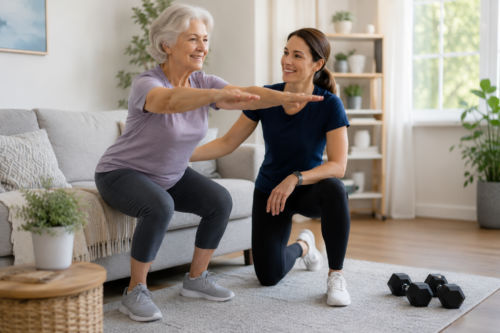
For older adults who want to feel stronger, move more easily, improve balance, stay independent, or simply feel more confident being active, a matched personal trainer can turn exercise from a vague intention into a realistic weekly routine.
Looking for the Right Personal Trainer?
RightFit Personal Training helps match you with a vetted personal trainer based on your goals, preferences, schedule, location, and training style. Whether you prefer in-home training, a local facility, outdoor sessions, or virtual support, RightFit can help you find a better fit.
Why In-Home Personal Training Works So Well for Older Adults
Many older adults know they should be more active, but consistency is often the hardest part. A gym membership alone does not solve the bigger barriers: transportation, confidence, accountability, equipment confusion, physical limitations, and lack of a clear plan.
In-home personal training removes many of those barriers. The trainer comes to the client, designs workouts around the available space, and adjusts exercises based on the person’s starting point.
1. There Is No Commute
Getting to and from a gym can become a reason to skip workouts. Weather, traffic, parking, mobility concerns, and busy schedules can all interfere. With in-home training, the session happens where the client already is. This makes it easier to stay consistent week after week.
2. The Workout Feels More Comfortable
Some older adults feel self-conscious exercising in public. Others simply prefer privacy. Training at home creates a more relaxed setting where the client can ask questions, learn at their own pace, and focus on proper movement without feeling watched.
3. Exercises Can Be Built Around Real-Life Movement
A strong fitness plan for older adults should support everyday life. That may include getting up from a chair, carrying groceries, walking stairs, improving posture, reaching overhead, stepping safely, or moving with more control. In-home training makes it easy to connect workouts to the movements a person actually uses every day.
4. The Trainer Can Use the Client’s Real Environment
A trainer can see the actual space where the client moves and exercises. That means workouts can be designed around the living room, kitchen counter, staircase, hallway, chair, resistance bands, dumbbells, or community fitness equipment available. The result is a plan that feels practical instead of generic.
What Should an Older Adult Work On With a Personal Trainer?
The best plan depends on the person, but most older adults benefit from a balanced routine that includes strength, balance, mobility, endurance, and recovery. A personal trainer can organize these pieces into a plan that is challenging but manageable.
A well-rounded in-home training plan may include:
- Strength training to support muscles used for standing, walking, lifting, carrying, and daily activity.
- Balance exercises to improve control, coordination, and confidence while moving.
- Mobility work to help joints move more comfortably through useful ranges of motion.
- Core training to support posture, stability, and efficient movement.
- Low-impact cardio to build stamina for daily life.
- Flexibility and recovery work to help the body feel better between sessions.
The goal is not to make workouts complicated. The goal is to make them consistent, safe for the individual’s ability level, and connected to outcomes the client actually cares about.
Example In-Home Personal Training Session for an Older Adult
Every client is different, but a typical session may follow a structure like this:
- Check-in: The trainer asks how the client is feeling, whether anything has changed, and what should be adjusted that day.
- Warm-up: Gentle movements prepare the body for exercise, such as marching in place, shoulder circles, sit-to-stand practice, or light mobility work.
- Strength work: Exercises may include chair squats, wall push-ups, resistance band rows, step-ups, light dumbbell movements, or supported lunges.
- Balance and control: The trainer may add supported single-leg balance, heel-to-toe walking, side steps, controlled weight shifts, or posture drills.
- Cardio or stamina work: Depending on the client, this may include walking intervals, low-impact circuits, or simple movement rounds.
- Cool-down: The session ends with breathing, stretching, mobility, and a review of what to practice before the next session.
Most importantly, a trainer can modify each exercise in real time. If something feels too easy, it can be progressed. If something feels too difficult, it can be simplified. That flexibility is one of the biggest advantages of one-on-one personal training.
Not Sure What Type of Trainer You Need?
RightFit can help match you with a personal trainer based on your goals, experience level, preferred location, schedule, budget, and training style. You do not have to search through endless profiles on your own.
How Often Should Older Adults Work With a Personal Trainer?
There is no single perfect schedule for every person. Some older adults work with a trainer once per week for accountability and guidance. Others prefer two or three sessions per week to build consistency faster. Some use in-home training as a starting point and then add independent walks, stretching, or simple strength exercises between sessions.
A practical starting point is often one to two personal training sessions per week, combined with light movement on other days. The right frequency depends on the client’s goals, current fitness level, confidence, schedule, and budget.
For someone who has not exercised in a while, the first goal may simply be building the habit. For someone who already walks regularly, the trainer may focus more on strength, balance, and mobility. For someone preparing for travel, golf, pickleball, gardening, or more active time with family, the plan may become more performance-focused.
What Equipment Is Needed for In-Home Senior Fitness Training?
Many older adults assume they need a full home gym to work with a trainer. In most cases, that is not true. A strong in-home workout can often be built with simple equipment and household items.
Helpful equipment may include:
- A sturdy chair
- Resistance bands
- Light dumbbells
- A yoga mat
- A countertop or wall for support
- A step or staircase when appropriate
- Comfortable athletic shoes
A good trainer can do a lot with a small amount of space. The focus should be on proper movement, steady progression, and consistency rather than expensive machines.
How to Choose the Right In-Home Personal Trainer for an Older Adult
Trainer fit matters. The best trainer is not always the loudest, most intense, or most expensive option. For older adults, the right trainer should be patient, professional, clear, encouraging, and able to adapt workouts to the client’s comfort level and goals.
Questions to ask before choosing a trainer:
- Does the trainer have experience working with older adults?
- Can the trainer modify exercises based on ability level?
- Does the trainer listen carefully and explain movements clearly?
- Is the trainer comfortable providing in-home sessions?
- Does the trainer’s personality match the client’s preferred coaching style?
- Can the trainer support goals like strength, balance, mobility, stamina, or general fitness?
- Does the trainer’s schedule align with the client’s routine?
This is one reason a trainer-matching service can be helpful. Instead of choosing blindly, clients can be matched based on practical preferences such as goals, location, training environment, specialty, price, gender preference, personality, and schedule.
In-Home Training vs. Gym Training for Older Adults
Both options can work. The better choice depends on the person.
In-home training is often best for older adults who want convenience, privacy, less travel, and a workout that fits their home environment. It is also helpful for beginners who feel more comfortable learning movement patterns away from a busy gym.
Gym-based training may be a better fit for someone who enjoys access to machines, heavier equipment, or a more social fitness setting. Some clients also like combining both: in-home sessions for consistency and gym sessions when they want more equipment variety.
The most important question is not “Which option is best?” It is “Which option will this person actually stick with?”
Who Is In-Home Personal Training Best For?
In-home personal training can be a strong fit for many older adults, including those who:
- Want to build strength but do not know where to start
- Feel intimidated by gyms
- Need more accountability to stay consistent
- Want to improve balance and coordination
- Prefer privacy while exercising
- Have a busy schedule or limited transportation
- Want workouts built around real-life movement
- Live in a building or community with a fitness room
- Want a trainer who can come to them
It can also be helpful for adult children researching fitness options for a parent. A matched trainer can provide structure, encouragement, and a consistent appointment that supports a more active lifestyle.
Find an In-Home Personal Trainer Near You
RightFit Personal Training helps clients find vetted personal trainers for in-home training, facility-based training, online training, and more. Share your goals and preferences, and RightFit will help match you with a trainer who fits your needs.
Frequently Asked Questions
Is in-home personal training good for older adults?
Yes, in-home personal training can be a great option for older adults because it is convenient, private, and personalized. A trainer can design workouts around the client’s goals, current ability level, available space, and preferred pace.
What does a personal trainer do for seniors?
A personal trainer can help older adults work on strength, balance, flexibility, mobility, posture, stamina, and confidence. The trainer also provides accountability, instruction, and exercise modifications when needed.
Do I need equipment for in-home personal training?
Not always. Many in-home workouts can be done with bodyweight exercises, a sturdy chair, resistance bands, light dumbbells, or basic household space. A trainer can recommend simple equipment based on the client’s goals.
How many times per week should an older adult use a personal trainer?
Many older adults start with one or two sessions per week. The best schedule depends on the person’s goals, fitness level, availability, and budget. A trainer can help build a realistic plan that supports consistency.
Can a personal trainer help with balance?
Yes. Many personal trainers include balance, coordination, lower-body strength, and controlled movement exercises in programs for older adults. These exercises can help clients feel more confident during everyday movement.
Is in-home training better than going to a gym?
It depends on the client. In-home training is ideal for people who want convenience, privacy, and a workout that fits their home. Gym training may be better for people who prefer more equipment or a gym atmosphere. The best choice is the one the client can follow consistently.
The Bottom Line
In-home personal training gives older adults a practical way to build strength, improve balance, move better, and stay consistent without needing to rely on a traditional gym routine. The right trainer can meet the client where they are, both physically and literally, and create a plan that fits their home, schedule, goals, and comfort level.
For older adults, fitness should not feel intimidating. It should feel useful, personal, and possible. With the right match, in-home personal training can help turn everyday movement into a stronger, more confident lifestyle.